

Worm tea (worm casting tea) is a liquid made by soaking castings in water, so their soluble nutrients and microbes can be watered or sprayed onto plants. It’s a way to stretch a small amount of castings over a larger area, and many gardeners like it as a gentle liquid feed.
It isn’t magic, and research results on its benefits are mixed. But it’s cheap, easy and does no harm when made properly.
Worm tea vs leachate
This is the most important distinction.
Worm tea is brewed on purpose by soaking finished castings in clean water.
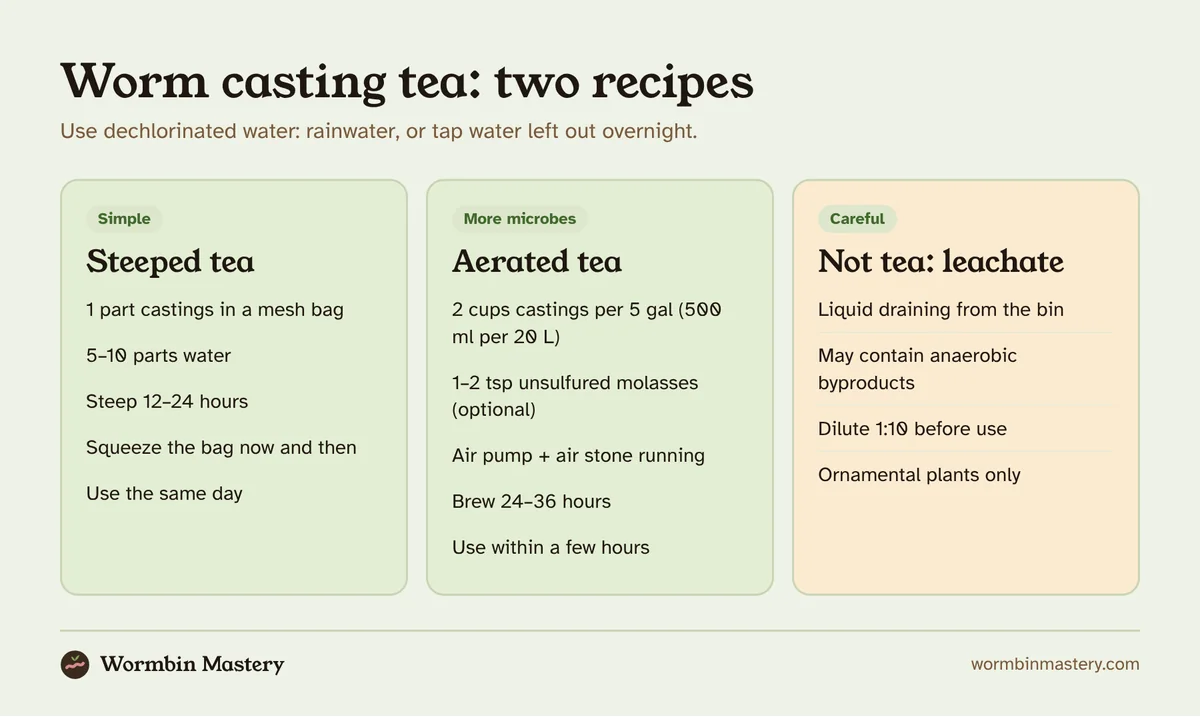
Leachate is the liquid that drains out of the bottom of a worm bin. It’s water that has passed through decomposing food and bedding, and it may contain anaerobic byproducts and partly broken-down food. It’s sometimes sold as “worm tea” but it isn’t the same thing.
Leachate can still be useful. Dilute it about 1 part to 10 parts water and use it on ornamental plants or pour it on a compost heap. Avoid using it neat or on edible leaves.
What you’ll need
- Finished worm castings, ideally screened
- A clean bucket, 1–5 gallons (4–20 liters)
- Dechlorinated water: rainwater, or tap water left out overnight
- An old pillowcase, mesh bag or nylon stocking
- For aerated tea: an aquarium air pump, tubing and an air stone
- Optional: a teaspoon or two of unsulfured molasses
 Related guideHow to Use Worm Castings in the Garden and on Houseplants
Method 1: Simple steeped tea
Best for: beginners and quick batches.
- Put about 1 part castings into a mesh bag.
- Submerge it in about 5–10 parts dechlorinated water. One cup of castings in half a gallon to a gallon of water (roughly 250 ml in 2–4 liters) is a good starting point.
- Leave it to steep for 12–24 hours, stirring or squeezing the bag occasionally.
- Remove the bag and use the tea straight away.
The spent castings in the bag can go on the garden.
Method 2: Aerated tea
Best for: gardeners who want to multiply the beneficial microbes.
Bubbling air through the brew keeps it oxygenated, which favors aerobic microbes and lets them multiply.
- Fill a 5 gallon (20 liter) bucket with dechlorinated water.
- Put about 2 cups (500 ml) of castings in a mesh bag and hang it in the water, or add them loose.
- Add 1–2 teaspoons of unsulfured molasses as food for microbes. This is optional.
- Put the air stone at the bottom and run the pump continuously.
- Brew for 24–36 hours.
- Use within a few hours of switching off the pump. Without air, the microbes use up oxygen quickly and the tea can turn anaerobic.
A finished aerated tea should smell earthy or slightly sweet. If it smells sour or rotten, don’t use it. Pour it on the compost and clean the equipment before the next batch.
How to use worm tea
As a soil drench
Water it directly onto the soil around plants. Use it undiluted or diluted up to 1:1 with water. This is the most common use.
As a foliar spray
Strain it through fine cloth so it doesn’t clog the sprayer. Spray onto leaves in the early morning or evening, not in hot sun. Cover the tops and undersides of leaves.
For edible crops, apply foliar sprays well before harvest and wash produce before eating, as with any homemade biological treatment.
How often
Every two to four weeks during the growing season is plenty for most plants. Houseplants can get a dose every month or two in spring and summer.
Is worm tea worth it?
The case for: it spreads the benefit of a small amount of castings over a much larger area, it’s easy to apply to many plants quickly, and many gardeners report healthier growth.
The case against: scientific studies show inconsistent results, especially for claims about disease suppression. Solid castings applied directly often give similar or better results with less effort.
A sensible view: if you have plenty of castings, apply them directly. If castings are limited or you want an easy liquid feed for containers and seedlings, tea is a good use of them. Our guide to how to use worm castings covers solid applications.
Tips for a good brew
- Use dechlorinated water. Chlorine can harm the microbes you’re trying to grow.
- Use mature castings. Fully processed castings from a healthy bin. See how to harvest worm castings.
- Clean equipment between batches. Biofilm in buckets and tubing can harbor unwanted organisms.
- Don’t store it. Use brewed tea the same day.
- Avoid too much molasses. More sugar doesn’t mean better tea, and excess can lead to sour brews.
Quick reference: ratios and timings
| Steeped tea | Aerated tea | |
|---|---|---|
| Castings | 1 part | About 2 cups per 5 gallons (500 ml per 20 L) |
| Water | 5–10 parts, dechlorinated | 5 gallons (20 L), dechlorinated |
| Additives | None | 1–2 tsp unsulfured molasses (optional) |
| Brewing time | 12–24 hours | 24–36 hours with air running |
| Use within | Same day | A few hours after the pump stops |
| Smell when ready | Earthy | Earthy or slightly sweet |
| Equipment | Bucket, bag | Bucket, bag, pump, tubing, air stone |
Troubleshooting a brew
- Smells sour or rotten: not enough oxygen or too much sugar. Discard it on a compost heap, clean the equipment and use less molasses next time.
- Thick foam on top: often from molasses. Usually harmless. Use a little less.
- Clogs the sprayer: strain through a fine cloth or an old T-shirt before spraying.
- Plants show no response: tea is a mild boost, not a strong fertilizer. Solid castings or compost may give a bigger effect.
Further reading: UConn Extension’s Vermicomposting guide discusses worm tea, and Oregon State University Extension’s Composting with Worms (EM 9034) covers using vermicompost.
Frequently asked questions
Can I store worm tea?
Not for long. Aerated tea should be used within a few hours. Steeped tea is best used the same day.
Can worm tea burn plants?
Properly made worm tea is very mild and unlikely to burn plants. Leachate used undiluted is more of a risk.
Do I need molasses?
No. Molasses feeds microbes in aerated brews and may increase their numbers, but tea works without it.
Can I use worm tea on seedlings?
Yes. Dilute it 1:1 with water and use it as an occasional drench once seedlings have their first true leaves. Our guide to castings for seed starting explains more.

