

Walk into a bait shop and you’ll find “nightcrawlers”. Order composting worms online and you’ll see “red wigglers”, “reds”, “Euros” and “African nightcrawlers”. The names overlap, and some of the worms behind them are completely unsuited to a bin.
This guide sorts out the confusion. You’ll learn which species actually compost, how they differ and which one fits your climate.
The short answer
- Red wigglers are the best all-round choice for beginners and most climates.
- European nightcrawlers work in bins too. They’re bigger, slower and great if you also fish.
- African nightcrawlers are fast eaters for consistently warm climates but suffer in cold.
- Canadian (common) nightcrawlers are soil burrowers. They don’t belong in a bin.
Why species matters
Earthworms fall into three broad lifestyles. Epigeic worms live in the surface litter of leaves, manure and rotting plants. They’re small, breed fast and eat rich organic material. Endogeic worms live in the upper soil and feed on soil itself. Anecic worms dig deep permanent burrows and pull leaves down from the surface.
A worm bin is a shallow, crowded layer of decaying organic matter. Only epigeic worms are adapted to that. They tolerate being packed together, breed quickly in rich material and don’t need deep soil. Everything in this guide that composts well is epigeic or close to it.
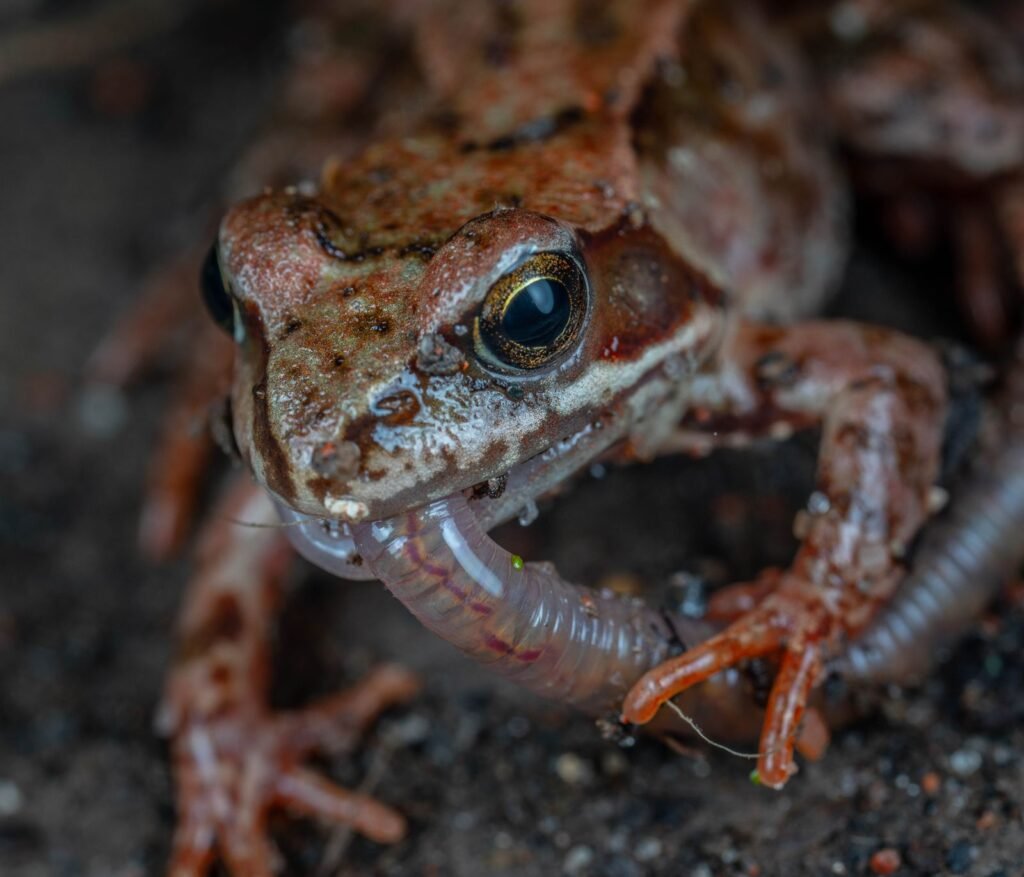
Red wigglers (Eisenia fetida)
Red wigglers are the standard composting worm almost everywhere. They’re 2–4 inches (5–10 cm) long, reddish-brown, and often have faint stripes between segments. A closely related species, Eisenia andrei, is sold under the same name and behaves the same way.
Why people choose them:
- Tolerate a wide temperature range, roughly 40–85 °F (4–30 °C), with an ideal of 59–77 °F (15–25 °C)
- Breed quickly once a bin settles
- Happy in shallow bins and crowded conditions
- Easy to buy in most countries
Downsides: They’re small, so they’re not much use as fishing bait. They also struggle in sustained heat above about 86 °F (30 °C).
 Related guideThe Best Place for a Worm Bin, Indoors and Outdoors
European nightcrawlers (Eisenia hortensis)
Also sold as “Euros” or Dendrobaena veneta, these are larger than red wigglers at 3–6 inches (8–15 cm), with a grey-pink body.
Strengths:
- Good bin worms that also make lively fishing bait
- Tolerate wetter bedding better than red wigglers
- Burrow a little deeper, which helps in taller bins
Downsides: They breed more slowly and process food more slowly per pound. They prefer deeper bedding of 10–12 inches (25–30 cm) and tend to wander if conditions aren’t to their liking.
African nightcrawlers (Eudrilus eugeniae)
These are big, fast-eating worms from tropical West Africa. In steady warmth they can process food impressively quickly, which makes them popular in hot regions and with commercial growers in warm climates.
Strengths:
- Very high food processing rate in warm conditions
- Large size, useful as bait
- Comfortable in heat that slows red wigglers down
Downsides: They’re sensitive to cold. Below about 60 °F (16 °C) they become sluggish, and cold snaps can kill them. They’re best for places like Sri Lanka, northern Australia, southern US states or indoor bins kept warm year-round.
Canadian nightcrawlers (Lumbricus terrestris)
This is the big nightcrawler you see on lawns after rain and buy in bait shops. It’s an anecic species that digs vertical burrows up to 6 feet (2 m) deep and prefers cool soil.
In a shallow bin, Canadian nightcrawlers can’t burrow, can’t escape the warmth of decomposing food and don’t breed well. Most die or try to leave within weeks. They’re great for fishing and for your garden soil, but don’t build a worm bin around them.
Side-by-side comparison
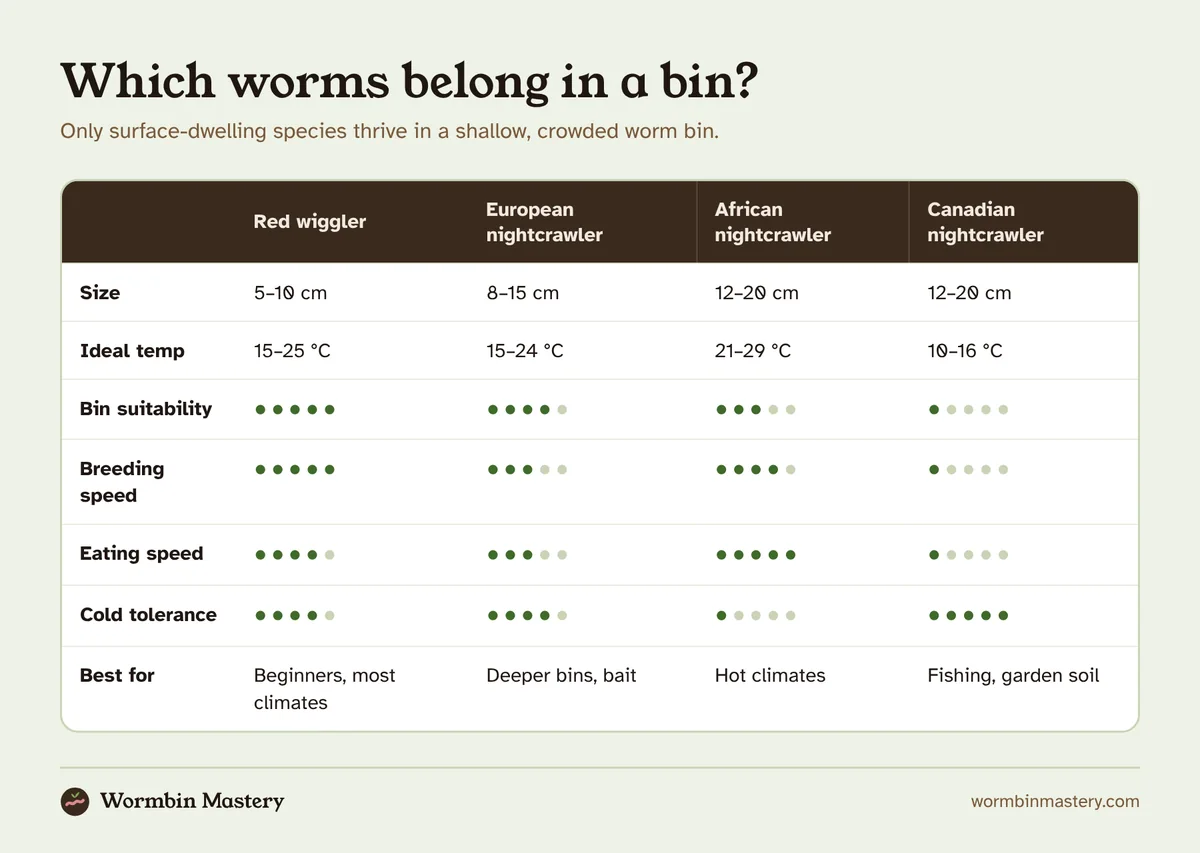
| Red wiggler | European nightcrawler | African nightcrawler | Canadian nightcrawler | |
|---|---|---|---|---|
| Size | 2–4 in (5–10 cm) | 3–6 in (8–15 cm) | 5–8 in (12–20 cm) | 5–8 in (12–20 cm) |
| Ideal temperature | 59–77 °F (15–25 °C) | 59–75 °F (15–24 °C) | 70–85 °F (21–29 °C) | 50–60 °F (10–16 °C) |
| Bin suitability | Excellent | Good | Good in warm climates | Poor |
| Breeding speed | Fast | Moderate | Fast when warm | Slow |
| Bait use | Small bait only | Very good | Good | Excellent |
Which should you choose?
Choose red wigglers if…
You’re a beginner, your bin is indoors or in a temperate climate, or you just want the most forgiving option. They’re the default for good reason.
Choose European nightcrawlers if…
You fish, you have a deeper bin, or your bin tends to run wet. Some people keep a mix of reds and Euros. They coexist, though reds often outcompete Euros over time in warm bins.
Choose African nightcrawlers if…
Your bin stays warm all year, for example in tropical climates or a heated room, and you want fast processing. Avoid them if winter temperatures in your bin’s spot drop below about 60 °F (16 °C).
Avoid Canadian nightcrawlers for composting
Save them for the tackle box or let them improve your garden soil instead.
How to tell what you’ve been sold
Mislabeled worms are common. A few clues help:
- Size: adult red wigglers rarely exceed 4 inches (10 cm). Much larger worms are probably Euros or Africans.
- Color: red wigglers are deep red-brown and often banded. Euros are grey-pink. Africans are purplish-grey with an iridescent sheen.
- Behavior: red wigglers thrash when picked up. Euros are more sluggish.
- Bait shop “nightcrawlers”: almost always Canadian nightcrawlers. Not suitable for a bin.
If you’re unsure, buy from a supplier that names the species in Latin. It’s a good sign they know what they’re selling.
Getting started with your worms
Once you’ve chosen a species, the next questions are how many worms you need and how to set up the bin. If you live somewhere hot, our guide to keeping worms alive in summer heat will help whichever species you pick.
Further reading: For more on red wigglers and bin species, see Oregon State University Extension’s Composting with Worms (EM 9034) and NC State Extension’s Worms Can Recycle Your Garbage.
Frequently asked questions
Can red wigglers and nightcrawlers live together?
Red wigglers and European nightcrawlers can share a bin. Canadian nightcrawlers won’t thrive in a bin regardless of company. In warm bins, red wigglers often become dominant over time because they breed faster.
Are red wigglers good for my garden soil?
Not really. They’re surface-litter worms, so they don’t survive long in ordinary garden soil without a thick layer of mulch or compost. Their real value to your garden is the castings they produce in the bin.
Will composting worms escape and invade my garden?
In most temperate regions red wigglers already live wild in manure and leaf piles, and escaped worms rarely spread far from rich organic material. Some regions have rules about releasing non-native worms, so check locally before dumping bin contents into wild areas.
Are African nightcrawlers worth it in a cold climate?
Only if the bin is indoors and stays above about 65 °F (18 °C) year-round. Otherwise red wigglers will give you more reliable results with less risk.

