

How many worms should you buy? Too few and your food scraps will rot faster than they can eat them. Buy too many and you’ve spent money on worms that would have bred for free in a few months. The good news is that the right number is easy to work out, and worm populations are forgiving.
How many worms you need: the short answer
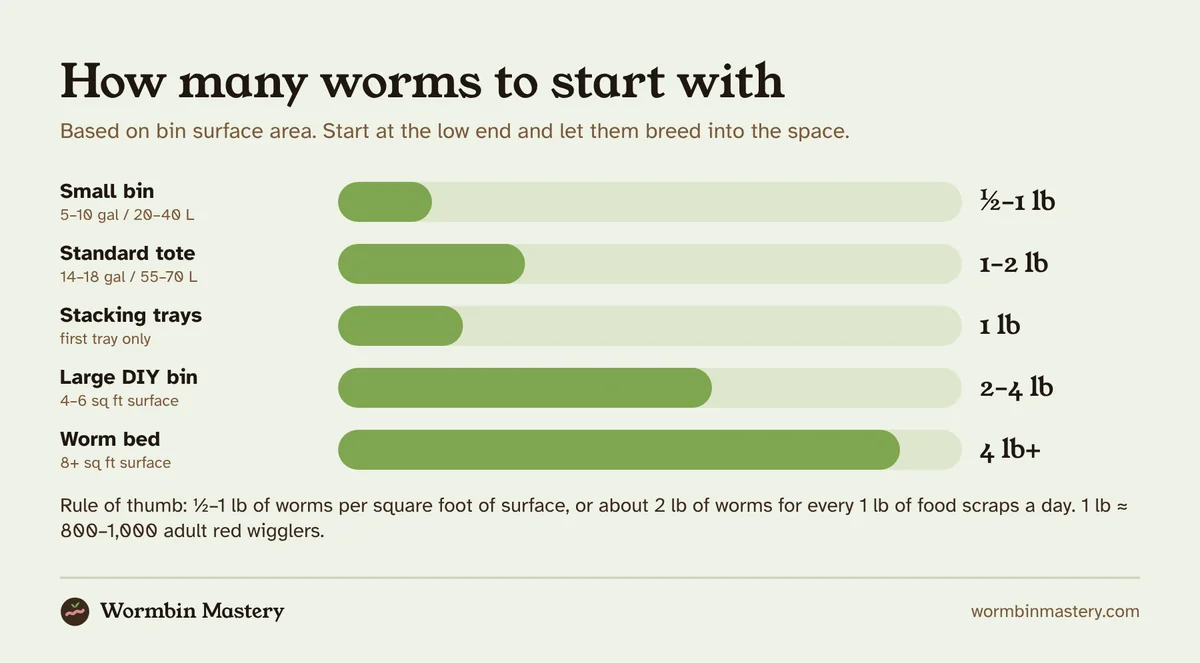
For most home bins, one pound (about 450 g) of red wigglers is the right start. That’s roughly 800–1,000 adult worms and suits a 10–14 gallon (40–55 liter) bin for a household of one to three people.
For bigger bins, use these two rules of thumb and pick whichever gives the higher number:
- Surface area: about ½ to 1 pound of worms per square foot (30 × 30 cm) of bin surface.
- Food scraps: about 2 pounds of worms for every pound of food scraps you produce per day.
Why surface area matters more than depth
Composting worms live and feed in the top 6–10 inches (15–25 cm) of bedding. A deep bin doesn’t hold more worms, it just holds more bedding below them. That’s why a wide, shallow tote can support more worms than a tall bucket of the same volume.
To measure surface area, multiply the inside length by the inside width:
- 24 × 16 inch tote = 384 square inches ≈ 2.7 square feet → 1.3–2.7 lb of worms at full capacity
- 60 × 40 cm tote = 2,400 cm² ≈ 2.6 square feet → similar
You don’t need to start at full capacity. Starting at the low end of the range is fine because the population grows to fit the space.

 Related guideRed Wigglers vs Nightcrawlers: Which Worms Belong in a Bin?
How many worms for the food you produce
An established, healthy population of red wigglers can eat roughly a quarter to half of its body weight per day in good conditions. In practice, home bins usually run at the lower end of that, especially in winter.
A simple calculation:
- Weigh your food scraps for a week.
- Divide by 7 for a daily figure.
- Multiply by 2 to get pounds of worms.
For example, a couple producing about 3.5 lb (1.6 kg) of vegetable scraps a week makes about 0.5 lb a day, which means about 1 lb of worms. A family of five producing 10 lb a week would want closer to 3 lb of worms, and a bin with at least 3 square feet of surface.
The calculators on our tools page can do this math for you.
Count by weight, not by number
Worms are sold by weight because counting them is impractical. One pound of mixed-size red wigglers usually contains 800–1,000 worms, but a pound of young worms can contain many more. Weight is the fairer measure of eating capacity.
What happens if you start with fewer worms?
Starting small is the most common and least risky approach. If you begin with half a pound in a bin that could hold two pounds:
- Feed less at first. Match food to the worms you have, not the bin you have.
- Expect the population to roughly double every two to three months in good conditions.
- Within six months to a year, most bins reach their natural carrying capacity.
The worms regulate themselves. When food and space run short, breeding slows. Our guide to how worms reproduce explains the timeline and what speeds it up.
What happens if you start with too many?
Overstocking is less common, but it happens with gifts from a friend’s bin or bulk orders. Signs include:
- Worms clustering on walls and the lid even after the first week
- Food disappearing within a day or two
- Bedding breaking down very quickly into castings
The fix is simple: feed a bit more, add fresh bedding, or split the population into a second bin. Overcrowded worms don’t die immediately. They slow down breeding and may become stressed if bedding turns to dense castings.
Starting numbers for popular bin setups
Small apartment bin (5–10 gallons / 20–40 liters)
Half a pound to one pound of worms. Feed about 1–2 cups of chopped scraps a week to start. Ideal for one or two people. Our guide to urban worm composting has setup tips for small spaces.
Standard tote (14–18 gallons / 55–70 liters)
One to two pounds of worms. Suits most households of two to four people.
Stacking tray system (3–5 trays)
One pound in the first tray. Worms migrate up as you add trays, so you don’t need more at the start.
Large DIY bin or worm bed (8+ square feet)
Four pounds or more, or start with two pounds and let them breed into the space over a season.
Buying worms: what to look for
- Species named clearly. You want red wigglers (Eisenia fetida or E. andrei). See our red wiggler vs nightcrawler comparison if you’re unsure.
- Weight of worms, not worms plus bedding. Some sellers ship “1 lb” that’s half bedding. Reputable suppliers state worm weight.
- Mixed sizes. A mix of adults and juveniles establishes faster than all-juvenile stock.
- Shipping timing. Avoid deliveries during heatwaves or hard freezes. Worms can cook or freeze in transit.
When they arrive, set them up straight away following our first-week walkthrough.
Further reading: Oregon State University Extension’s Composting with Worms (EM 9034) explains how many worms to start with for different bin sizes, and NC State Extension’s Worms Can Recycle Your Garbage covers bin sizing too.
Frequently asked questions
Can I start a worm bin with just a few worms?
Yes, but it will take a long time to become useful. A starter of 100 worms might take a year or more to reach a population that can handle a household’s scraps. If you’re patient and feed very little, it works. Most people prefer to start with at least half a pound.
How many worms can one bin hold?
Breeding slows and worm numbers plateau. You’ll see lots of small worms but fewer cocoons, and food disappears at a steady rate rather than faster each month. That’s a good time to split the bin or harvest castings.
Do I need more worms in winter?
No. Worms eat less in cooler temperatures, so you’ll simply feed less. The population usually recovers its pace in spring.
Is it better to buy worms or get them from a friend?
Both work. A scoop of bedding from an established bin brings worms, cocoons and helpful microbes, so a new bin often settles faster. Just check the donor bin is healthy and free of pests like red mites first.


