
How often you feed worms matters more than what you feed them: overfeeding causes more failed worm bins than any other mistake. It’s also the hardest one to judge, because the right amount changes as your bin matures, as temperatures shift and as your worm population grows.
This guide gives you a simple starting schedule and, more importantly, the signs that tell you when to adjust.
The golden rule for when to feed worms
Feed when most of the last meal is gone. Not on a fixed calendar, not when you happen to have scraps, but when you can see the worms have worked through most of what you gave them last time.
Everything else in this guide is a way to apply that rule.
How much can worms eat?
You’ll often read that worms eat half their body weight a day. That figure comes from established bins in ideal conditions: warm, moist, with soft pre-softened food and a large microbial population. In real home bins, especially new ones, intake is usually much lower.
A more useful way to think about it:
- New bin (weeks 1–4): a small fraction of their weight per week
- Settled bin (months 2–3): roughly a quarter of their weight per day in warm months
- Mature bin (month 4+): up to half their weight per day in ideal conditions
For one pound (450 g) of worms, that means anything from a cup of scraps a week at the start to 3 pounds (1.4 kg) of food a week once everything is humming.
 Related guide12 Foods to Keep Out of Your Worm Bin, and Why
A week-by-week plan for a new bin
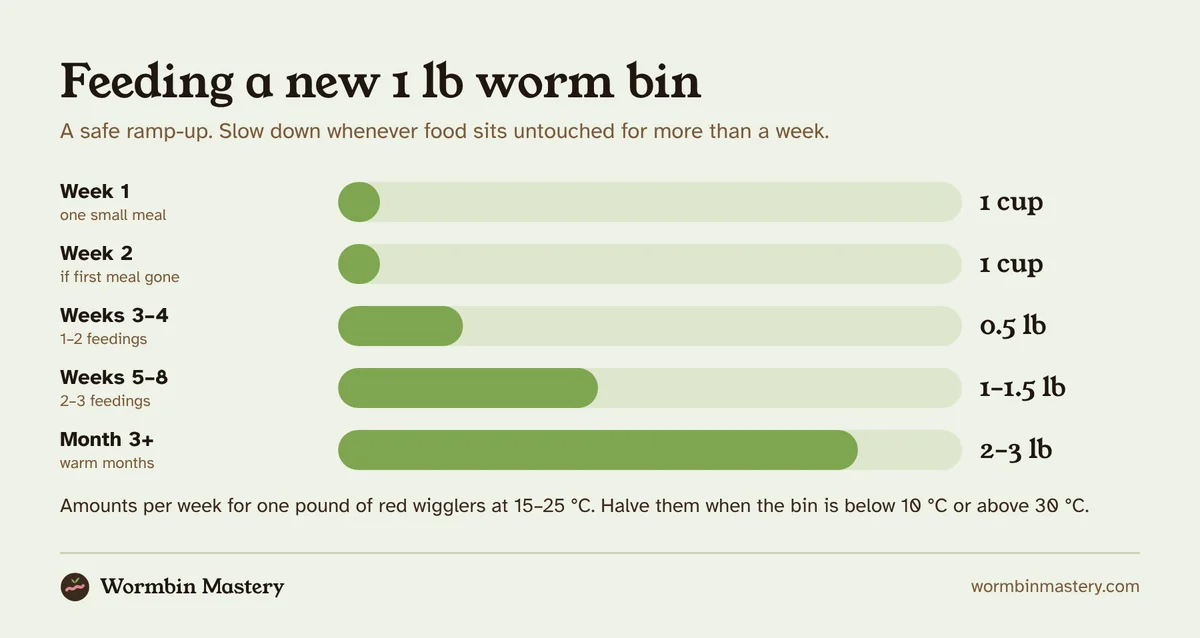
This schedule assumes one pound of red wigglers in a 10–14 gallon bin kept at 59–77 °F (15–25 °C). Scale up or down for different worm quantities.
Week 1
One feeding of about 1 cup (roughly 200 g) of soft chopped scraps, buried in one corner. Then wait. Our first-week walkthrough explains what to expect.
Week 2
If the first meal is mostly gone, add another cup in a different spot. If not, wait.
Weeks 3–4
Increase to 1–2 cups per feeding, once or twice a week, as long as food is disappearing within about a week.
Weeks 5–8
Most bins can handle 1–1.5 lb (450–700 g) per week by now. Feed two or three times a week in smaller portions rather than one large dump.
Month 3 onward
Keep increasing slowly while food continues to disappear within four or five days. Many established one-pound bins settle at 2–3 lb (900 g–1.4 kg) per week in warm weather.
Feeding frequency: little and often vs once a week
Both approaches work.
Little and often (every two or three days) keeps a steady food supply and reduces the risk of a big mass of food going sour. It suits indoor bins and people who add scraps daily.
Once a week works if you freeze scraps through the week and feed in one go. Bury food in two or three pockets rather than one large heap.
What doesn’t work is irregular, very large feedings: nothing for three weeks, then a whole bag of scraps.
Where to put the food
Bury it
Always bury food under at least 1–2 inches (3–5 cm) of bedding. Exposed food dries out, smells and attracts fruit flies. Read how to get rid of fruit flies if they’ve already arrived.
Rotate spots
Divide the bin mentally into four or six sections and feed a different one each time. When you return to the first, check whether the food has gone. It’s an easy built-in progress check.
Cover with carbon
Add a handful of dry shredded cardboard or paper on top of each feeding. It balances the moisture in the food and keeps the surface fresh.
Signs you’re overfeeding
- Food from two or more feedings ago still recognizable
- Sour, rotten or ammonia smell. See our smell troubleshooting guide.
- Bedding becoming wet and sticky
- Lots of white or colored mold. See mold in a worm bin.
- Fruit flies, fungus gnats or mites multiplying
- Worms crowding on the walls and lid
- The bin feeling warm to the touch in the middle
If you notice two or more of these, stop feeding for a week or two and add dry bedding.
Signs you’re underfeeding
Underfeeding is rare and much less harmful. Signs include:
- Food disappearing within a day or two every time
- Bedding breaking down very quickly into fine castings
- Worms looking thin and small
Increase portions gradually. If bedding is turning to castings fast, add fresh bedding too, because worms eat bedding when food runs short.
Adjusting for the seasons
Temperature changes how much worms eat more than anything else.
- Below 50 °F (10 °C): worms slow dramatically. Cut feeding by half or more.
- 59–77 °F (15–25 °C): peak eating. This is when you can feed the most.
- Above 86 °F (30 °C): worms eat less and food rots faster. Feed small amounts of cool, soft food. See keeping worms alive in summer heat.
The temperature safety checker tells you how your bin’s current reading affects feeding.
Going on vacation
A healthy, established bin can go three to four weeks without feeding. Before you leave:
- Feed a normal portion about a week before you go, not a huge one the day before.
- Add a thick layer of fresh, damp bedding.
- Move the bin somewhere with a stable temperature.
Worms will eat bedding and the microbes in it while you’re away.
A simple feeding log
Keeping a quick log for the first two months makes it much easier to find your bin’s rhythm. Note the date, roughly how much you fed, where you buried it, the bin temperature and whether the previous meal was gone. After a few weeks, you’ll see a pattern and can feed with confidence.
Further reading: Oregon State University Extension’s Composting with Worms (EM 9034) has more on how often to feed worms, and NC State Extension’s Worms Can Recycle Your Garbage covers feeding by bin size.
Frequently asked questions
Can I feed worms every day?
Yes, in small amounts, once your bin is established. A daily handful buried in rotating spots works well. Just keep an eye on whether earlier food is being eaten.
How long can worms go without food?
Healthy worms in good bedding can go three to four weeks without added food, because they eat the bedding itself. Longer gaps slow breeding and growth.
Why is my worm bin not eating food?
The usual causes are a new bin that hasn’t built up microbes yet, low temperatures, food that’s too hard or too large, or a bin that’s too wet or acidic. Chop food smaller, check temperature and moisture, and be patient.
Should I weigh my scraps?
Not forever. Weighing for the first few weeks helps you calibrate what “a cup” or “a pound” looks like. After that, your eyes and the golden rule are enough.

